Maslow's Hierarchy of Needs
Picture this: you went on a nice bushwalk on a crisp winter's day, but you've strolled off the path and now you're hopelessly lost. You've just finished your bag of nuts, your water bottle's empty, and your phone's out of range. As the the sun sets on a cold evening, your heart races and panic sets in. What's at the top of your list of concerns? Appreciating the natural beauty? Taking photos of the beautiful sunset? More likely: survival at any cost.
You start making a mental list of survival strategies. Are you going to hunker down and try to start a fire? Is there a stream nearby for drinking water? Which plants are edible? Suddenly you hear a noise - a car! You scramble through the bushes onto a road. Your car's parked just around the corner! There's food and water in the boot, and the heater warms your bones. As you drive home, the panic subsides. What to do now? Perhaps call your mum to tell her you're okay? Call your friends and make plans for dinner? The sun's still setting - maybe take a photo and get some Instagram 'likes'?
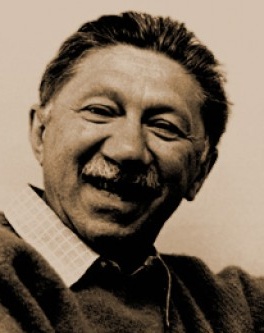 Abraham Maslow (1943) was a US psychologist who co-founded the humanistic psychology movement which emerged in the post-World War II years. This 'Third Force' of psychology saw Maslow and other psychologists such as Carl Rogers and Viktor Frankl push back against psychology's tendency to focus on pathology [mental illness] and 'rats and pigeons' behaviourism based on lab work. Maslow was especially interested in high-functioning successful people, and his most well-known work is the Hierarchy of Needs model of human motivation (1943; 1948).
Maslow’s (1943) Hierarchy of Needs model arranges common human needs into five motivational levels: at the bottom are physiological or survival needs, where the individual focuses on acquiring life’s necessities [air, water etc.]; next are safety needs [personal security, accommodation etc.]; third, belongingness and love needs, which include the person’s interaction and affiliation with others; fourth, esteem needs, where the individual strives toward achievement and seeks external recognition for these achievements; and finally, at the top of the original model is self-actualisation, which is the fulfillment of individual human potential. As the needs at each level are achieved by the individual, the motivation emerges to seek out and satisfy the needs of the next (Maslow, 1998).
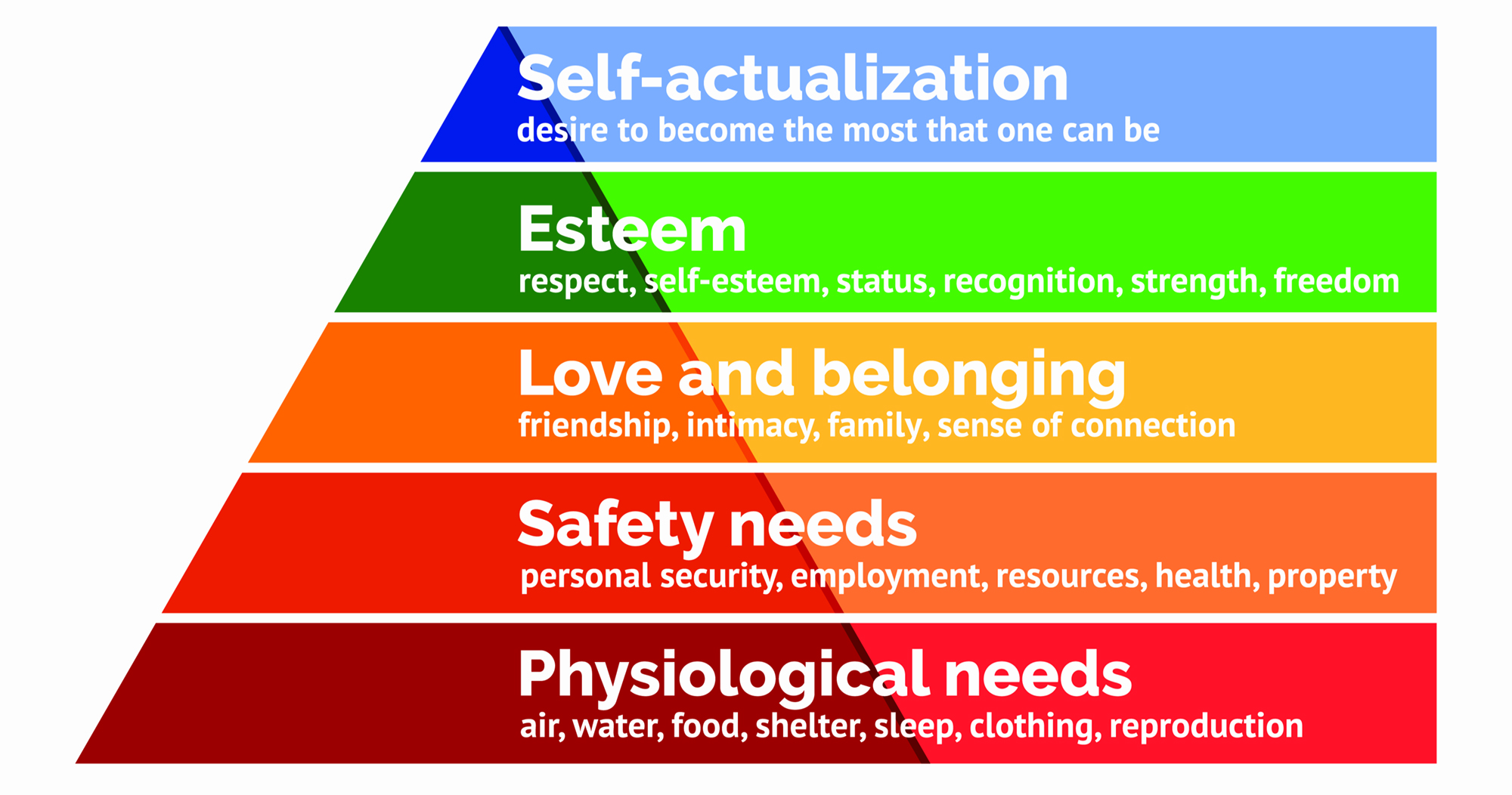 It is important to understand that your position on the hierarchy is never static. Depending on your circumstances, at a given time you could occupy any level of the model. Take, for example, the bushwalk situation described above, or how people's needs have changed dramatically during the COVID-19 pandemic.
Generally speaking, however, 'self-actualising' people tend to have the needs of the first four levels satisfied.
**Note: Maslow actually intended his model to feature an even higher level than self-actualisation: the motivation towards self-transcendence, where the self-actualised individual seeks to advance causes beyond the self [such as a dedication to helping others] and actively pursues 'peak experiences' (Koltko-Rivera, 2006). This is an important point which we will return to at a later point on the course.
For optional extra reading about current perspectives on Maslow and the Hierarchy of Needs, check out: